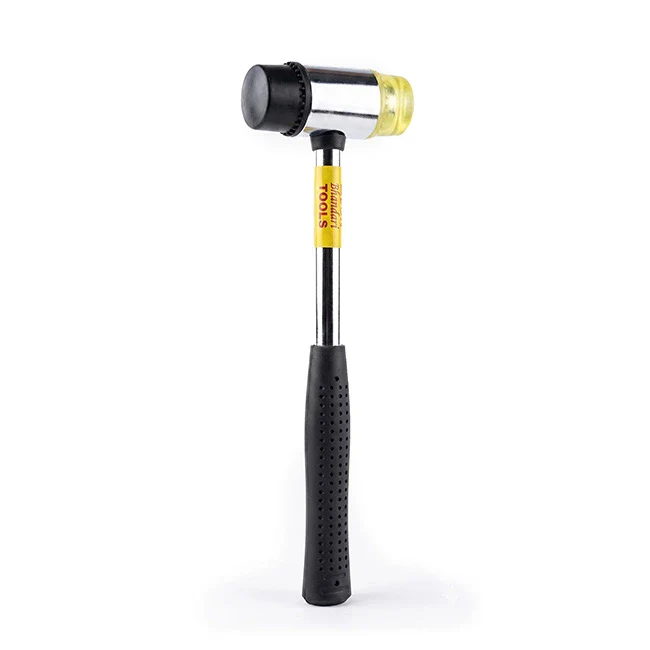
Jon Bhandari Two-Way Soft-Face Mallet
Product Highlights
- Brand: Jon Bhandari Tools
- Product: Two-Way Mallet Hammer - Dual Head Soft Face
- Heads: Rubber and nylon (35mm face diameter)
- Hammer Head Width: 90mm
- Handle Length: 240mm (approx. 9.4 inches)
- Handle Material: Strong wooden handle
- Grip: Comfortable shock-absorbing TPR grip
- Weight: 425 g
- Package Contents: 1x Two-Way Mallet Hammer 35mm
- Package Dimensions (L x W x H): 30 x 10 x 5 cm
- Application: Bending, forming, shaping, and flattening metal - tile setting, panel alignment, and surface work without marring
Product Description
Jon Bhandari Two-Way Mallet Hammer is a dual-head soft-face mallet with a 35mm rubber head on one side and a 35mm nylon head on the other, mounted on a strong wooden handle with a shock-absorbing TPR grip. The handle is 240mm long (approximately 9.4 inches) and the total mallet weight is 425g - a compact, well-balanced tool suited to both bench work and on-site use. The two-head design gives the user a choice of impact hardness for the task at hand: the rubber head for softer, more cushioned strikes, and the nylon head for firmer impacts - both leaving no marks or damage on the struck surface.
The primary design purpose of this mallet is bending, forming, shaping, and flattening metal without leaving unwanted marks on the surface - a task where a steel hammer would deform or dent the workpiece. It is equally effective for tile setting, panel and cabinet alignment, laminate and engineered flooring installation, and any assembly or installation task where a non-marring strike is required. The 90mm head width distributes the strike force across a wider contact area, reducing the risk of point-load damage on tiles, panels, or finished surfaces. The wooden handle absorbs vibration and the TPR grip reduces hand fatigue during extended use.
Key Features
- Dual rubber and nylon heads (35mm): Rubber for soft cushioned strikes, nylon for firmer impacts - both non-marring on metal, tile, and finished surfaces
- 90mm head width: Wide contact face distributes force evenly - reduces point-load damage risk on tiles and panels
- Strong wooden handle (240mm): Absorbs vibration and provides a comfortable, balanced grip for extended use
- Shock-absorbing TPR grip: Reduces hand fatigue and improves control during repeated strikes
- Non-marring strikes: Shapes, bends, and forms metal without dents or marks - essential for metalwork, tile setting, and cabinet alignment
Technical Specifications
Technical Specifications (Quick Reference)
| Specification | Details |
|---|---|
| Brand | Jon Bhandari Tools |
| Product Type | Dual-Head Soft-Face Mallet Hammer |
| Head Types | Rubber and nylon |
| Face Diameter | 35mm |
| Hammer Head Width | 90mm |
| Handle Length | 240mm (approx. 9.4 inches) |
| Handle Material | Strong wooden handle |
| Grip | Shock-absorbing TPR grip |
| Weight | 425 g |
| Package Contents | 1x Two-Way Mallet Hammer 35mm |
| Package Dimensions (L x W x H) | 30 x 10 x 5 cm |
Usage Guidelines
How to Use
- Select the correct head: Use the rubber head for softer, more cushioned strikes on delicate surfaces - tiles, finished wood, or soft metal. Use the nylon head for firmer impacts where more force is needed while still preventing surface marks.
- Grip and stance: Hold the TPR grip firmly with a relaxed wrist - the shock-absorbing grip reduces vibration feedback. The 240mm handle provides comfortable leverage without excessive swing arc.
- Metal forming and shaping: Strike the workpiece with progressive, controlled blows rather than single heavy impacts - build up the shape gradually to maintain control over the deformation.
- Tile setting: Use to tap tiles evenly into adhesive mortar - work from the centre outward to ensure full adhesive coverage and consistent bed depth across the tile face.
- Maintenance: Clean the rubber and nylon heads after use to remove adhesive, grout, or debris. Store in a dry location - prolonged exposure to moisture can degrade the rubber head over time.
Recommended Applications
Where the Jon Bhandari Two-Way Mallet fits best
- Metal bending, forming, and shaping: The primary design purpose - shaping and flattening sheet metal, metal profiles, and fabricated components without leaving dents or hammer marks on the surface
- Tile setting: Tapping tiles into adhesive mortar for proper seating and full adhesive coverage without cracking or chipping the tile face
- Panel and cabinet alignment: Adjusting wood panels, cabinet carcasses, and modular furniture components into position without surface damage
- Laminate and engineered flooring: Tapping floor planks together at joints without damaging edges or surface finish
- Trim and moulding installation: Installing timber trim and architraves without denting or marking the finished surface
- General assembly: Any bench or site assembly task requiring a controlled, non-marring strike
Why Buy from HomeRun?
- Authentic Jon Bhandari Product: Verified genuine product from authorized distributors
- Fresh Stock: All tools in optimal condition for immediate use
- Bangalore Fulfilment: Quick local availability with express delivery
FAQs
1) When should I use the rubber head versus the nylon head?
Use the rubber head for softer, more cushioned strikes - delicate tile surfaces, finished wood, thin sheet metal, or any surface where even the nylon head may leave a mark. Use the nylon head for firmer impacts where more striking force is needed - seating stubborn tiles into thick adhesive, driving wooden joints together, or forming thicker metal sections that need more force. Both heads are non-marring compared to a steel hammer, but the rubber head is the gentler of the two.
2) Is this mallet suitable for metalwork, or only for tile and flooring?
Metalwork is the primary design purpose of this mallet - it is specifically engineered for bending, forming, shaping, and flattening metal without leaving unwanted dents or hammer marks on the surface. Sheet metal workers, fabricators, and metalworking tradespeople use soft-face mallets to shape metal precisely without the surface damage that a steel hammer causes. Tile setting and flooring installation are equally valid applications, but the tool was designed first for non-marring metal forming.
3) Why is the handle only 240mm - is that not quite short?
The 240mm (approx. 9.4 inches) handle is the correct length for a precision striking tool - it provides close control over strike placement and force, which is what metalwork and tile setting require. A longer handle gives more swing momentum for heavy demolition work but reduces precision. For shaping metal and setting tiles, you want controlled, accurate taps rather than heavy blows - the 240mm handle is optimised for this type of work.
4) Will the rubber head degrade over time with regular use?
The rubber head will wear gradually with regular use - this is normal and expected for a soft-face striking tool. The rate of wear depends on the hardness of the surfaces being struck and the force used. Clean the heads after each use to remove adhesive, grout, and debris, and store in a dry location - prolonged moisture exposure accelerates rubber degradation. When the rubber face becomes significantly worn, flattened, or cracked, the head can be replaced to restore the tool's performance.
5) Can I use this mallet for laminate flooring installation?
Yes - the soft-face mallet is the standard tool for tapping laminate and engineered flooring planks together at their tongue-and-groove joints. Use a tapping block between the mallet and the plank edge to distribute the force evenly across the full joint length - striking the plank edge directly, even with a soft-face mallet, can damage the locking profile of the laminate. The rubber head is the recommended side for flooring work as it distributes force more softly than the nylon head.
Returns & Exchange Policy
- This product is non-returnable
- Replacement available within 24 hours of delivery for:
- Damaged or defective product
- Wrong or missing item
- Refer to Refund Policy for complete details
Original: $1.89
-70%$1.89
$0.57More Images


Jon Bhandari Two-Way Soft-Face Mallet
Product Highlights
- Brand: Jon Bhandari Tools
- Product: Two-Way Mallet Hammer - Dual Head Soft Face
- Heads: Rubber and nylon (35mm face diameter)
- Hammer Head Width: 90mm
- Handle Length: 240mm (approx. 9.4 inches)
- Handle Material: Strong wooden handle
- Grip: Comfortable shock-absorbing TPR grip
- Weight: 425 g
- Package Contents: 1x Two-Way Mallet Hammer 35mm
- Package Dimensions (L x W x H): 30 x 10 x 5 cm
- Application: Bending, forming, shaping, and flattening metal - tile setting, panel alignment, and surface work without marring
Product Description
Jon Bhandari Two-Way Mallet Hammer is a dual-head soft-face mallet with a 35mm rubber head on one side and a 35mm nylon head on the other, mounted on a strong wooden handle with a shock-absorbing TPR grip. The handle is 240mm long (approximately 9.4 inches) and the total mallet weight is 425g - a compact, well-balanced tool suited to both bench work and on-site use. The two-head design gives the user a choice of impact hardness for the task at hand: the rubber head for softer, more cushioned strikes, and the nylon head for firmer impacts - both leaving no marks or damage on the struck surface.
The primary design purpose of this mallet is bending, forming, shaping, and flattening metal without leaving unwanted marks on the surface - a task where a steel hammer would deform or dent the workpiece. It is equally effective for tile setting, panel and cabinet alignment, laminate and engineered flooring installation, and any assembly or installation task where a non-marring strike is required. The 90mm head width distributes the strike force across a wider contact area, reducing the risk of point-load damage on tiles, panels, or finished surfaces. The wooden handle absorbs vibration and the TPR grip reduces hand fatigue during extended use.
Key Features
- Dual rubber and nylon heads (35mm): Rubber for soft cushioned strikes, nylon for firmer impacts - both non-marring on metal, tile, and finished surfaces
- 90mm head width: Wide contact face distributes force evenly - reduces point-load damage risk on tiles and panels
- Strong wooden handle (240mm): Absorbs vibration and provides a comfortable, balanced grip for extended use
- Shock-absorbing TPR grip: Reduces hand fatigue and improves control during repeated strikes
- Non-marring strikes: Shapes, bends, and forms metal without dents or marks - essential for metalwork, tile setting, and cabinet alignment
Technical Specifications
Technical Specifications (Quick Reference)
| Specification | Details |
|---|---|
| Brand | Jon Bhandari Tools |
| Product Type | Dual-Head Soft-Face Mallet Hammer |
| Head Types | Rubber and nylon |
| Face Diameter | 35mm |
| Hammer Head Width | 90mm |
| Handle Length | 240mm (approx. 9.4 inches) |
| Handle Material | Strong wooden handle |
| Grip | Shock-absorbing TPR grip |
| Weight | 425 g |
| Package Contents | 1x Two-Way Mallet Hammer 35mm |
| Package Dimensions (L x W x H) | 30 x 10 x 5 cm |
Usage Guidelines
How to Use
- Select the correct head: Use the rubber head for softer, more cushioned strikes on delicate surfaces - tiles, finished wood, or soft metal. Use the nylon head for firmer impacts where more force is needed while still preventing surface marks.
- Grip and stance: Hold the TPR grip firmly with a relaxed wrist - the shock-absorbing grip reduces vibration feedback. The 240mm handle provides comfortable leverage without excessive swing arc.
- Metal forming and shaping: Strike the workpiece with progressive, controlled blows rather than single heavy impacts - build up the shape gradually to maintain control over the deformation.
- Tile setting: Use to tap tiles evenly into adhesive mortar - work from the centre outward to ensure full adhesive coverage and consistent bed depth across the tile face.
- Maintenance: Clean the rubber and nylon heads after use to remove adhesive, grout, or debris. Store in a dry location - prolonged exposure to moisture can degrade the rubber head over time.
Recommended Applications
Where the Jon Bhandari Two-Way Mallet fits best
- Metal bending, forming, and shaping: The primary design purpose - shaping and flattening sheet metal, metal profiles, and fabricated components without leaving dents or hammer marks on the surface
- Tile setting: Tapping tiles into adhesive mortar for proper seating and full adhesive coverage without cracking or chipping the tile face
- Panel and cabinet alignment: Adjusting wood panels, cabinet carcasses, and modular furniture components into position without surface damage
- Laminate and engineered flooring: Tapping floor planks together at joints without damaging edges or surface finish
- Trim and moulding installation: Installing timber trim and architraves without denting or marking the finished surface
- General assembly: Any bench or site assembly task requiring a controlled, non-marring strike
Why Buy from HomeRun?
- Authentic Jon Bhandari Product: Verified genuine product from authorized distributors
- Fresh Stock: All tools in optimal condition for immediate use
- Bangalore Fulfilment: Quick local availability with express delivery
FAQs
1) When should I use the rubber head versus the nylon head?
Use the rubber head for softer, more cushioned strikes - delicate tile surfaces, finished wood, thin sheet metal, or any surface where even the nylon head may leave a mark. Use the nylon head for firmer impacts where more striking force is needed - seating stubborn tiles into thick adhesive, driving wooden joints together, or forming thicker metal sections that need more force. Both heads are non-marring compared to a steel hammer, but the rubber head is the gentler of the two.
2) Is this mallet suitable for metalwork, or only for tile and flooring?
Metalwork is the primary design purpose of this mallet - it is specifically engineered for bending, forming, shaping, and flattening metal without leaving unwanted dents or hammer marks on the surface. Sheet metal workers, fabricators, and metalworking tradespeople use soft-face mallets to shape metal precisely without the surface damage that a steel hammer causes. Tile setting and flooring installation are equally valid applications, but the tool was designed first for non-marring metal forming.
3) Why is the handle only 240mm - is that not quite short?
The 240mm (approx. 9.4 inches) handle is the correct length for a precision striking tool - it provides close control over strike placement and force, which is what metalwork and tile setting require. A longer handle gives more swing momentum for heavy demolition work but reduces precision. For shaping metal and setting tiles, you want controlled, accurate taps rather than heavy blows - the 240mm handle is optimised for this type of work.
4) Will the rubber head degrade over time with regular use?
The rubber head will wear gradually with regular use - this is normal and expected for a soft-face striking tool. The rate of wear depends on the hardness of the surfaces being struck and the force used. Clean the heads after each use to remove adhesive, grout, and debris, and store in a dry location - prolonged moisture exposure accelerates rubber degradation. When the rubber face becomes significantly worn, flattened, or cracked, the head can be replaced to restore the tool's performance.
5) Can I use this mallet for laminate flooring installation?
Yes - the soft-face mallet is the standard tool for tapping laminate and engineered flooring planks together at their tongue-and-groove joints. Use a tapping block between the mallet and the plank edge to distribute the force evenly across the full joint length - striking the plank edge directly, even with a soft-face mallet, can damage the locking profile of the laminate. The rubber head is the recommended side for flooring work as it distributes force more softly than the nylon head.
Returns & Exchange Policy
- This product is non-returnable
- Replacement available within 24 hours of delivery for:
- Damaged or defective product
- Wrong or missing item
- Refer to Refund Policy for complete details
Product Information
Product Information
Shipping & Returns
Shipping & Returns
Description
Product Highlights
- Brand: Jon Bhandari Tools
- Product: Two-Way Mallet Hammer - Dual Head Soft Face
- Heads: Rubber and nylon (35mm face diameter)
- Hammer Head Width: 90mm
- Handle Length: 240mm (approx. 9.4 inches)
- Handle Material: Strong wooden handle
- Grip: Comfortable shock-absorbing TPR grip
- Weight: 425 g
- Package Contents: 1x Two-Way Mallet Hammer 35mm
- Package Dimensions (L x W x H): 30 x 10 x 5 cm
- Application: Bending, forming, shaping, and flattening metal - tile setting, panel alignment, and surface work without marring
Product Description
Jon Bhandari Two-Way Mallet Hammer is a dual-head soft-face mallet with a 35mm rubber head on one side and a 35mm nylon head on the other, mounted on a strong wooden handle with a shock-absorbing TPR grip. The handle is 240mm long (approximately 9.4 inches) and the total mallet weight is 425g - a compact, well-balanced tool suited to both bench work and on-site use. The two-head design gives the user a choice of impact hardness for the task at hand: the rubber head for softer, more cushioned strikes, and the nylon head for firmer impacts - both leaving no marks or damage on the struck surface.
The primary design purpose of this mallet is bending, forming, shaping, and flattening metal without leaving unwanted marks on the surface - a task where a steel hammer would deform or dent the workpiece. It is equally effective for tile setting, panel and cabinet alignment, laminate and engineered flooring installation, and any assembly or installation task where a non-marring strike is required. The 90mm head width distributes the strike force across a wider contact area, reducing the risk of point-load damage on tiles, panels, or finished surfaces. The wooden handle absorbs vibration and the TPR grip reduces hand fatigue during extended use.
Key Features
- Dual rubber and nylon heads (35mm): Rubber for soft cushioned strikes, nylon for firmer impacts - both non-marring on metal, tile, and finished surfaces
- 90mm head width: Wide contact face distributes force evenly - reduces point-load damage risk on tiles and panels
- Strong wooden handle (240mm): Absorbs vibration and provides a comfortable, balanced grip for extended use
- Shock-absorbing TPR grip: Reduces hand fatigue and improves control during repeated strikes
- Non-marring strikes: Shapes, bends, and forms metal without dents or marks - essential for metalwork, tile setting, and cabinet alignment
Technical Specifications
Technical Specifications (Quick Reference)
| Specification | Details |
|---|---|
| Brand | Jon Bhandari Tools |
| Product Type | Dual-Head Soft-Face Mallet Hammer |
| Head Types | Rubber and nylon |
| Face Diameter | 35mm |
| Hammer Head Width | 90mm |
| Handle Length | 240mm (approx. 9.4 inches) |
| Handle Material | Strong wooden handle |
| Grip | Shock-absorbing TPR grip |
| Weight | 425 g |
| Package Contents | 1x Two-Way Mallet Hammer 35mm |
| Package Dimensions (L x W x H) | 30 x 10 x 5 cm |
Usage Guidelines
How to Use
- Select the correct head: Use the rubber head for softer, more cushioned strikes on delicate surfaces - tiles, finished wood, or soft metal. Use the nylon head for firmer impacts where more force is needed while still preventing surface marks.
- Grip and stance: Hold the TPR grip firmly with a relaxed wrist - the shock-absorbing grip reduces vibration feedback. The 240mm handle provides comfortable leverage without excessive swing arc.
- Metal forming and shaping: Strike the workpiece with progressive, controlled blows rather than single heavy impacts - build up the shape gradually to maintain control over the deformation.
- Tile setting: Use to tap tiles evenly into adhesive mortar - work from the centre outward to ensure full adhesive coverage and consistent bed depth across the tile face.
- Maintenance: Clean the rubber and nylon heads after use to remove adhesive, grout, or debris. Store in a dry location - prolonged exposure to moisture can degrade the rubber head over time.
Recommended Applications
Where the Jon Bhandari Two-Way Mallet fits best
- Metal bending, forming, and shaping: The primary design purpose - shaping and flattening sheet metal, metal profiles, and fabricated components without leaving dents or hammer marks on the surface
- Tile setting: Tapping tiles into adhesive mortar for proper seating and full adhesive coverage without cracking or chipping the tile face
- Panel and cabinet alignment: Adjusting wood panels, cabinet carcasses, and modular furniture components into position without surface damage
- Laminate and engineered flooring: Tapping floor planks together at joints without damaging edges or surface finish
- Trim and moulding installation: Installing timber trim and architraves without denting or marking the finished surface
- General assembly: Any bench or site assembly task requiring a controlled, non-marring strike
Why Buy from HomeRun?
- Authentic Jon Bhandari Product: Verified genuine product from authorized distributors
- Fresh Stock: All tools in optimal condition for immediate use
- Bangalore Fulfilment: Quick local availability with express delivery
FAQs
1) When should I use the rubber head versus the nylon head?
Use the rubber head for softer, more cushioned strikes - delicate tile surfaces, finished wood, thin sheet metal, or any surface where even the nylon head may leave a mark. Use the nylon head for firmer impacts where more striking force is needed - seating stubborn tiles into thick adhesive, driving wooden joints together, or forming thicker metal sections that need more force. Both heads are non-marring compared to a steel hammer, but the rubber head is the gentler of the two.
2) Is this mallet suitable for metalwork, or only for tile and flooring?
Metalwork is the primary design purpose of this mallet - it is specifically engineered for bending, forming, shaping, and flattening metal without leaving unwanted dents or hammer marks on the surface. Sheet metal workers, fabricators, and metalworking tradespeople use soft-face mallets to shape metal precisely without the surface damage that a steel hammer causes. Tile setting and flooring installation are equally valid applications, but the tool was designed first for non-marring metal forming.
3) Why is the handle only 240mm - is that not quite short?
The 240mm (approx. 9.4 inches) handle is the correct length for a precision striking tool - it provides close control over strike placement and force, which is what metalwork and tile setting require. A longer handle gives more swing momentum for heavy demolition work but reduces precision. For shaping metal and setting tiles, you want controlled, accurate taps rather than heavy blows - the 240mm handle is optimised for this type of work.
4) Will the rubber head degrade over time with regular use?
The rubber head will wear gradually with regular use - this is normal and expected for a soft-face striking tool. The rate of wear depends on the hardness of the surfaces being struck and the force used. Clean the heads after each use to remove adhesive, grout, and debris, and store in a dry location - prolonged moisture exposure accelerates rubber degradation. When the rubber face becomes significantly worn, flattened, or cracked, the head can be replaced to restore the tool's performance.
5) Can I use this mallet for laminate flooring installation?
Yes - the soft-face mallet is the standard tool for tapping laminate and engineered flooring planks together at their tongue-and-groove joints. Use a tapping block between the mallet and the plank edge to distribute the force evenly across the full joint length - striking the plank edge directly, even with a soft-face mallet, can damage the locking profile of the laminate. The rubber head is the recommended side for flooring work as it distributes force more softly than the nylon head.
Returns & Exchange Policy
- This product is non-returnable
- Replacement available within 24 hours of delivery for:
- Damaged or defective product
- Wrong or missing item
- Refer to Refund Policy for complete details